What we do
Eight pillars of change. One collective future.
To equip students with the knowledge, skills, emotional resilience and values needed to thrive academically, socially and professionally — while supporting schools in creating safe, inclusive and future-ready learning environments aligned with CBSE guidelines.
The eight sessions
Across our eight programme areas, we bring together emotional well-being, identity, culture, safety, digital and financial awareness, creativity, the environment, compassion and inclusion.
Manobal
Building strong minds before crisis begins
Manobal is Sammati’s mental health and emotional resilience initiative, designed to nurture emotionally aware, confident and resilient young individuals.
Mental health is not only about overcoming challenges — it is about equipping young people with the emotional strength, self-awareness and resilience needed to navigate life with confidence.
Today’s children and adolescents are growing up in a rapidly changing world shaped by academic pressures, social expectations, digital influences and constant transitions. According to the World Health Organization, 1 in 7 adolescents globally experiences a mental health condition, while suicide remains one of the leading causes of death among young people worldwide. Research further shows that half of all mental health conditions begin before the age of 14, highlighting the importance of early intervention and emotional skill-building.
The programme moves beyond awareness and focuses on developing practical life skills that help children and adolescents understand themselves, regulate emotions and build healthy relationships. It works through experiential learning, reflection exercises, guided discussions and age-appropriate activities.
Manobal is grounded in the understanding that emotional resilience is not an inborn trait — it is a skill that can be nurtured through supportive environments and consistent practice. WHO emphasises that protective family, school and community environments play a critical role in promoting adolescent mental well-being and helping young people develop healthy coping and problem-solving abilities.
Rather than treating mental health as a one-time conversation, Manobal creates continuous opportunities for young people to reflect, connect and grow. By fostering emotional literacy, positive relationships and help-seeking behaviour, the programme aims to create a generation that is not only academically capable but also emotionally strong, self-aware and equipped to thrive in an increasingly complex world.
Because resilience is not built when life is easy — it is built when young minds learn how to navigate life’s challenges with strength, hope and support.
- Recognise and understand emotions
- Build self-awareness and self-confidence
- Develop healthy coping mechanisms for stress and adversity
- Strengthen communication and interpersonal skills
- Cultivate empathy and emotional intelligence
- Seek support without fear or stigma
- Build resilience in the face of challenges and change
Vyaktitva
Empowering young minds to discover their potential and shape their future
Vyaktitva helps young people discover their strengths, explore possibilities and build the confidence needed to navigate their personal, academic and professional journeys.
In a world where careers are evolving faster than ever before, preparing young people for the future requires more than academic knowledge. It requires self-awareness, adaptability, confidence and the ability to make informed decisions in an increasingly complex and dynamic environment.
According to the World Economic Forum, millions of jobs are expected to transform over the coming decade, with employers increasingly valuing skills such as critical thinking, communication, creativity, problem-solving and adaptability alongside technical expertise. At the same time, many young people make educational and career choices with limited exposure to the wide range of opportunities available to them.
The programme encourages participants to look inward before looking outward — helping them understand their interests, values, aspirations and unique potential while developing the skills required to thrive in the future world of work and life. It runs through interactive workshops, self-assessment activities, mentoring, experiential learning and guided reflection.
Vyaktitva recognises that career readiness is not simply about choosing a profession — it is about developing the awareness, competencies and mindset needed to make informed choices throughout life. The programme equips young people with the ability to evaluate opportunities, respond to change and pursue pathways that align with their ambitions and circumstances.
Rather than directing participants towards a specific career, Vyaktitva empowers them to become active architects of their own futures. By combining self-discovery with practical life and career skills, the programme nurtures confident, capable and future-ready individuals who are prepared not only to succeed in a changing world, but also to contribute meaningfully to it.
Because the future belongs not only to those who dream — but to those who understand themselves, embrace possibilities and confidently take the next step forward.
- Identify their strengths, interests and aspirations
- Build self-confidence and a positive self-image
- Develop effective communication and interpersonal skills
- Strengthen leadership, teamwork and decision-making abilities
- Set meaningful goals and create actionable plans
- Explore diverse educational and career pathways
- Build adaptability, resilience and a growth mindset
- Prepare for future opportunities with clarity and confidence
Dharohar
Preserving roots. Inspiring creativity. Building cultural confidence.
Dharohar helps children and youth connect with their cultural roots while developing creativity, critical thinking and appreciation for diversity.
In an increasingly interconnected world, young people are exposed to diverse ideas, influences and identities. While this creates new opportunities, it also highlights the importance of understanding one’s roots, heritage and cultural identity. Research consistently shows that a strong sense of cultural belonging contributes to greater self-esteem, social connectedness and emotional well-being, particularly among young people.
The programme transforms culture from something that is merely observed into something that is experienced, explored and expressed. Through storytelling, traditional arts, crafts, music, theatre, literature, folk knowledge, local histories and community engagement, participants discover how cultural heritage shapes identities, values and collective memory.
They are encouraged not only to learn about traditions but also to interpret, question and reimagine them in ways that remain relevant to contemporary society.
Dharohar views culture not as a static legacy preserved in the past, but as a living, evolving force that shapes communities and inspires innovation. By engaging with heritage through creative participation and dialogue, young people develop the confidence to celebrate their own identities while embracing the richness of others.
The programme ultimately seeks to nurture culturally aware, creatively confident and socially connected individuals who understand where they come from, appreciate the diversity around them and contribute to preserving and enriching cultural heritage for future generations.
Because heritage is more than what we inherit — it is what we understand, celebrate and carry forward with pride.
- Develop a stronger sense of identity, belonging and cultural pride
- Explore India’s diverse traditions, histories and artistic practices
- Enhance creativity, imagination and self-expression through the arts
- Build appreciation and respect for cultural diversity and inclusion
- Strengthen communication, storytelling and creative thinking skills
- Connect intergenerational knowledge with modern perspectives
- Foster curiosity, empathy and understanding across communities
- Become active custodians and ambassadors of cultural heritage
Drishtikon
From ideas to impact: preparing young minds for a changing world
Drishtikon nurtures young innovators, responsible digital citizens and informed decision-makers, equipping them to question, solve, create and choose well.
The future belongs to those who can think critically, adapt confidently and make informed decisions in an increasingly complex world. Yet success in the 21st century requires more than academic achievement — it demands curiosity, creativity, problem-solving, financial awareness and digital responsibility.
Today’s young people are growing up in a world shaped by rapid technological change, evolving careers and an expanding digital economy. They are expected not only to consume information but to evaluate it, not only to use technology but to navigate it responsibly, and not only to identify challenges but to create solutions. Developing these competencies early is essential for building capable, confident and future-ready citizens.
Rooted in the belief that every child has the potential to become a creator, problem-solver and changemaker, the programme encourages young people to observe their surroundings, ask meaningful questions, challenge assumptions and transform ideas into action. It works through experiential learning, real-world problem-solving, design thinking, financial awareness activities and digital literacy exercises.
Drishtikon views entrepreneurship not merely as business creation, but as the ability to identify opportunities, take initiative and create positive change. Similarly, digital and financial literacy are not treated as technical subjects alone, but as essential life skills that empower young people to participate confidently and responsibly in modern society.
By combining innovation, entrepreneurship, financial awareness and digital responsibility within a single learning ecosystem, Drishtikon aligns with Sammati’s vision of nurturing empowered, informed and future-ready individuals. It prepares young people not only to succeed in a rapidly evolving world, but also to contribute thoughtfully, ethically and creatively to the communities around them.
Because the leaders of tomorrow are not defined by what they know alone, but by how they think, what they create and the choices they make.
- Think creatively and approach challenges with confidence
- Apply problem-solving and design-thinking principles to real-life situations
- Build initiative, leadership and entrepreneurial mindsets
- Transform ideas into meaningful projects and community solutions
- Understand fundamental financial concepts and responsible money management
- Make informed decisions about spending, saving and planning
- Navigate digital platforms safely, ethically and responsibly
- Evaluate information critically and recognise misinformation and online risks
- Protect personal data and practise responsible digital citizenship
- Adapt to change, embrace innovation and learn through experimentation
Sajag
Creating safe spaces, strengthening trusted relationships
Sajag strengthens the ecosystem of care around every child — equipping adults to create safe, supportive environments, and children with age-appropriate personal safety awareness.
Every child deserves more than protection — they deserve to grow in environments where they feel heard, respected, understood and safe. While children develop resilience, confidence and life skills through their own experiences, the adults around them play a defining role in shaping those experiences.
Parents, caregivers and educators are often the first to notice changes in behaviour, emotions or social interactions. Yet in a rapidly changing world — where children navigate both physical and digital environments — understanding their needs requires more than supervision. It requires awareness, empathy, open communication and informed action.
The programme empowers adults with the knowledge, skills and confidence needed to create safe, supportive and nurturing environments where children can thrive. At the same time, Sajag equips children with age-appropriate awareness about personal safety, healthy boundaries, trusted relationships and responsible digital engagement. The focus is not on fear or restriction, but on building understanding, confidence and the ability to seek help when needed.
Sajag recognises that child protection is not a single intervention — it is a culture of awareness, trust and shared responsibility. When families, schools and communities work together, children are more likely to feel secure, supported and empowered to reach their full potential.
Aligned with Sammati’s vision of creating informed, healthy and empowered communities, Sajag seeks to build a network of vigilant adults and confident children who together contribute to safer homes, safer schools and safer digital spaces.
Because every child flourishes when the people around them are aware, responsive and committed to creating environments where safety, trust and dignity come first.
- For adults — understand child and adolescent development more effectively
- For adults — recognise behavioural, emotional and social indicators that may require attention
- For adults — foster trust-based communication and active listening
- For adults — create emotionally safe and supportive learning environments
- For adults — strengthen positive discipline and relationship-building practices
- For adults — understand emerging challenges in digital spaces and online interactions
- For children — understand personal safety and healthy boundaries
- For children — identify trusted adults and support systems
- For children — develop confidence to communicate concerns and seek help
- For children — recognise unsafe situations in both physical and digital environments
- For children — strengthen self-advocacy, confidence and decision-making skills
Punarchakra
Nurturing responsible citizens for a sustainable tomorrow
Punarchakra inspires children and young people to understand the relationship between people, communities and the natural world — and to act on it.
The future of our planet will be shaped by the choices we make today. From climate change and resource depletion to waste management and biodiversity loss, environmental challenges are no longer distant concerns — they are realities that directly affect communities, livelihoods and future generations.
Young people are inheriting a world that demands not only awareness of environmental issues but also the knowledge, values and skills needed to become active stewards of the planet. Building a sustainable future begins with fostering a sense of responsibility, connection and action at an early age.
The programme transforms environmental awareness into meaningful action by encouraging participants to adopt sustainable practices and contribute to positive change within their surroundings. Through experiential learning, community engagement, nature-based activities and sustainability projects, participants explore environmental challenges while discovering practical solutions that can be implemented in everyday life.
Punarchakra views sustainability not simply as environmental protection, but as a way of thinking and living that balances social, economic and ecological well-being. By connecting local actions with global challenges, the programme helps young people understand that even small, consistent efforts can create meaningful impact.
Aligned with Sammati’s vision of creating informed, empowered and responsible communities, Punarchakra seeks to nurture environmentally conscious citizens who value nature, embrace sustainable living and take collective responsibility for the world they will inherit.
Because sustainability is not just about protecting the environment — it is about creating a future where people, communities and nature thrive together.
- Develop environmental awareness and ecological responsibility
- Understand the interconnectedness of people, communities and natural ecosystems
- Learn sustainable habits related to water, energy and resource conservation
- Explore waste management, recycling and circular economy principles
- Appreciate biodiversity and the importance of protecting natural resources
- Strengthen critical thinking and problem-solving through environmental challenges
- Participate in community-led sustainability initiatives
- Build leadership and advocacy skills for environmental action
- Cultivate responsible consumption and environmentally conscious decision-making
- Become active contributors to a greener and more sustainable future
Jeevlok
Fostering empathy for every living being
Jeevlok cultivates empathy, awareness and responsible action towards animals and the natural world.
A compassionate society is reflected in the way it treats its most vulnerable members — including animals. From companion animals and urban wildlife to farm animals and biodiversity, every living being plays a role in maintaining the balance of our shared ecosystem. Yet rapid urbanisation, habitat loss and limited awareness often create challenges that affect both animals and communities.
Helping young people understand and respect the lives of animals nurtures more than kindness — it develops empathy, responsibility, environmental consciousness and a deeper appreciation for the interconnectedness of all life.
The programme encourages children and young people to see animals not merely as part of their surroundings, but as living beings deserving of care, respect and protection. Through interactive learning, storytelling, community engagement, awareness campaigns and experiential activities, participants explore the relationship between humans, animals and ecosystems while developing values that promote compassion and responsible citizenship.
Jeevlok recognises that animal welfare is not only an environmental concern but also a social and ethical responsibility. Research consistently shows that empathy towards animals is closely linked to empathy towards people, helping young individuals develop stronger emotional intelligence, compassion and civic responsibility.
Aligned with Sammati’s vision of building informed, sensitive and empowered communities, Jeevlok seeks to nurture a generation that values all forms of life and understands the importance of living in harmony with nature.
Because when young minds learn to care for every living being, they grow into individuals who build a kinder, more compassionate and more sustainable world for all.
- Develop empathy, kindness and respect towards animals
- Understand the role of animals in maintaining ecological balance
- Learn responsible behaviour around companion animals and wildlife
- Recognise issues related to animal welfare, abandonment and cruelty
- Appreciate biodiversity and the importance of protecting habitats
- Build awareness about humane and ethical treatment of animals
- Encourage responsible community participation in animal welfare efforts
- Strengthen environmental stewardship through understanding interconnected ecosystems
- Develop leadership and advocacy skills for positive social and environmental change
- Foster a culture of compassion, coexistence and shared responsibility
Samavesh
Every learner belongs. Every ability matters.
Samavesh strengthens participation, independence and dignity across generations — bringing together inclusive education, accessibility awareness, special education support and elderly well-being.
Education and inclusion become truly meaningful when every individual — regardless of age, ability, disability, learning differences or life circumstances — has the opportunity to participate with dignity, independence and equal opportunity.
Children do not learn in the same way, at the same pace or through the same pathways. Similarly, older adults may experience changing physical, social, digital and accessibility needs as they age. Samavesh seeks to build environments that respond to these diverse needs rather than expecting individuals to adapt to systems that were not designed for them.
The programme works through sensitisation programmes, capacity-building, inclusive learning activities, accessibility-focused interventions and community engagement, creating more responsive and compassionate families, institutions and communities.
Samavesh views inclusion as more than physical access. True inclusion means creating environments where people can communicate, learn, contribute, make choices and feel that they belong — at every stage of life. The programme therefore looks beyond individual needs and focuses on the ecosystem of support: families, educators, caregivers, peers, institutions, communities and local systems.
By bringing children with diverse abilities and older adults into the larger conversation on inclusion, Samavesh also creates opportunities for intergenerational learning and connection — where experience can meet curiosity, knowledge can be shared, and communities can grow stronger together.
Aligned with Sammati’s vision of a society where every individual has access to opportunity, dignity and support, Samavesh works towards a future where differences are understood, ageing is respected, barriers are challenged and diversity is recognised as a strength.
Because inclusion has no age limit — it is about creating a world where every person has the opportunity to belong, participate, contribute and thrive.
- Creating awareness around disability, learning differences, ageing and accessibility
- Promoting inclusive and barrier-free educational and community environments
- Equipping educators and caregivers with practical strategies for diverse needs
- Encouraging accessible communication, teaching and learning practices
- Supporting families in understanding and responding to the needs of children and older adults
- Promoting dignity, independence and participation among senior citizens
- Addressing social isolation and encouraging meaningful intergenerational engagement
- Building awareness around age-friendly and disability-friendly spaces
- Supporting digital literacy and safe technology use among older adults
- Identifying barriers to participation and developing practical, community-based solutions
- Strengthening confidence, self-advocacy and everyday independence
Together, these areas form an interconnected approach to helping young people build the knowledge, attitudes and skills needed to participate confidently in their families, schools, communities and wider society.
The partnership
How a partnership works
Invitation and assessment
We begin only where we’re invited — by a school, a district education office, or a community organisation already working there. The first eight weeks are assessment: reading and numeracy baselines, a teacher survey, a facilities audit, and conversations with parents.
Design
We adapt the programme areas to what the assessment found. A school with strong learning outcomes and no well-being support gets a different mix from one where both are weak. The plan is written down and shared with the school before anything starts.
Delivery
Programmes run through the academic year, on the school’s timetable, alongside its teachers. Sammati facilitators are present in the building on fixed days, not on request.
Handover
From year two, every programme has a named teacher being trained to run it. By the end of year three, they are running it and we are supporting.
Review and publication
Termly review with the school. Annual publication of what changed — including what didn’t.
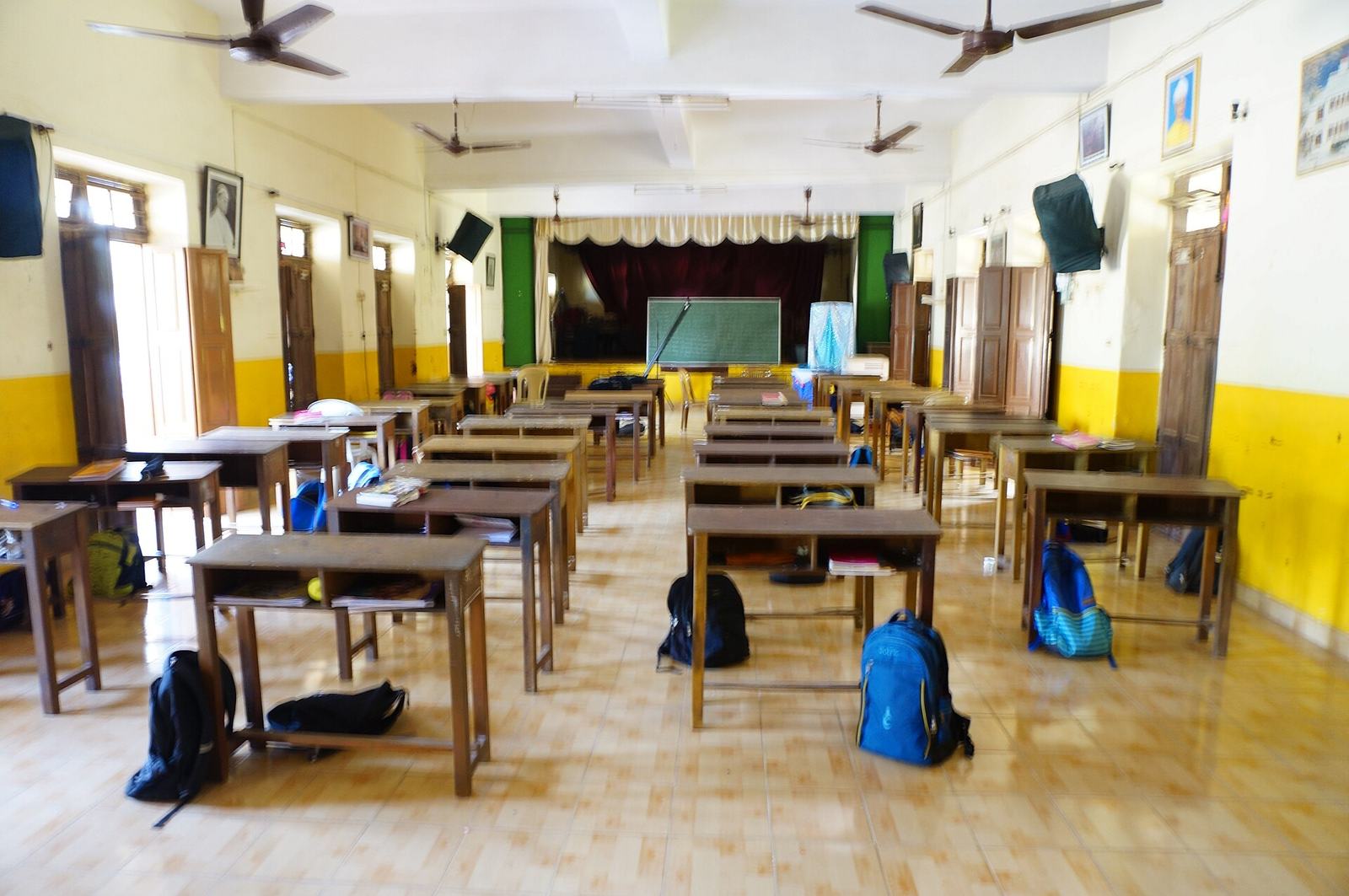
Photography: Fredericknoronha (CC BY-SA 4.0) · via Wikimedia Commons, colour-treated · representative, not documentation of Sammati's work
What we don’t do
Being clear about limits is part of being trustworthy.
We don’t provide clinical treatment. Our team recognises and refers. Diagnosis and therapy are for licensed professionals, and we maintain referral relationships so that the handover actually happens.
We don’t run parallel schools. We work inside the government system, with its teachers and its timetable.
We don’t do single-day interventions. If we can only be somewhere once, we’d rather not start.
We don’t collect student data we don’t need. Assessment data stays with the school. Nothing identifying a child leaves it.